
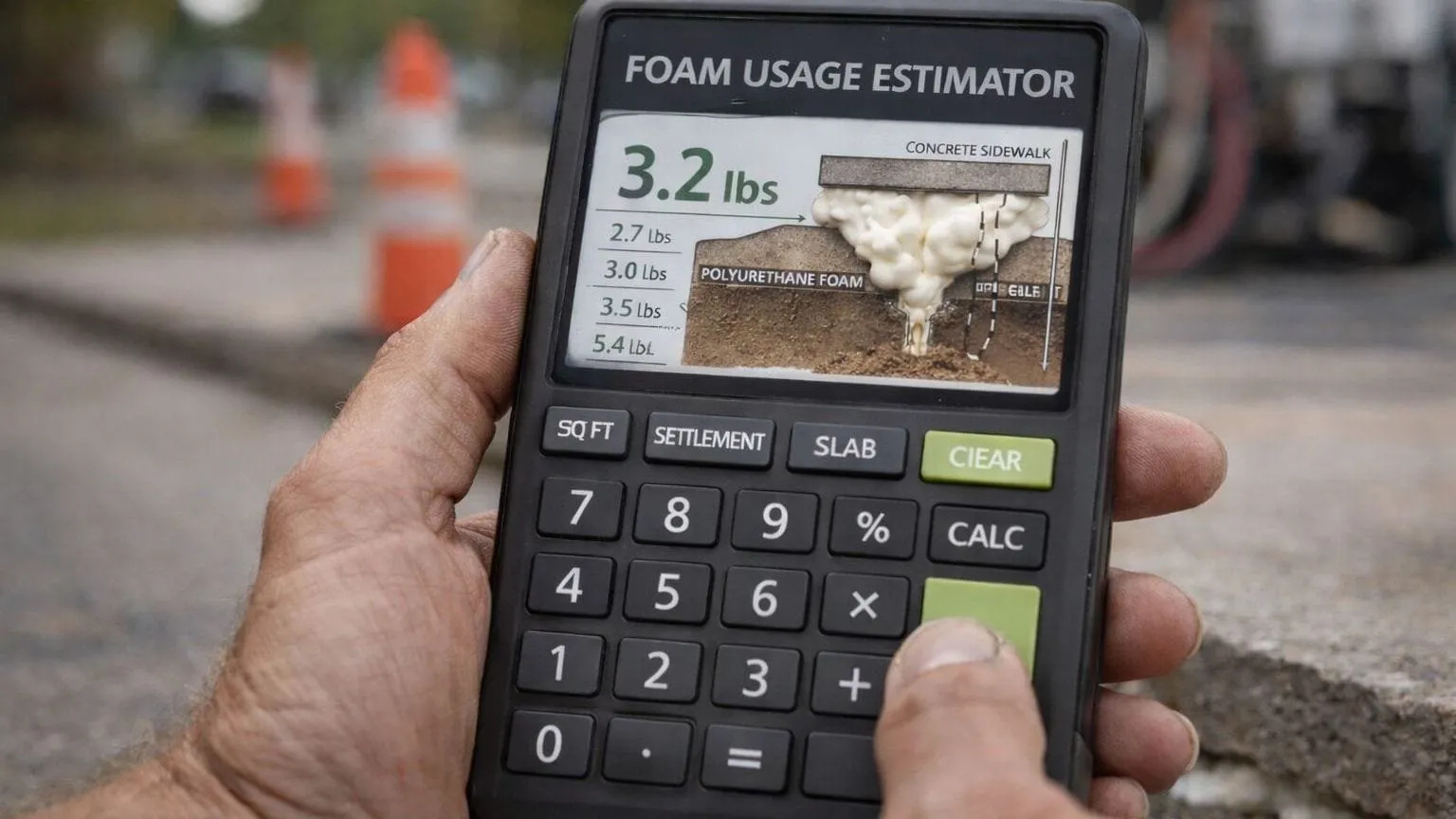
Estimating polyurethane foam in the real world
If you’ve been in concrete raising for any amount of time, you already estimate foam on every job. You may not even think about it as “estimating” anymore — it’s just part of how you look at a slab, read the site, and decide what makes sense. The challenge isn’t that contractors don’t know how to estimate. The challenge is that foam usage lives at the intersection of math, experience, and uncertainty, and different tools emphasize different parts of that equation.
That’s why two contractors can look at the same job and come up with numbers that are close — but not identical — and both still be acting responsibly.
The reality: everyone already has a method
Across the industry, there are several common ways foam usage gets determined. Some contractors rely on spreadsheets they’ve refined over years of trial and error. Others work from square-foot assumptions, time-and-material pricing, or calculators built into CRMs and equipment ecosystems. Many of those tools share a common framework for describing settlement using one-side, two-side, and three-side scenarios.
In that framework, “one side” generally represents straightforward differential settlement along an edge, “two side” describes corner or diagonal settlement that appears more complex, and “three side” represents uniform settlement across the entire slab. This language is still used every day because it provides a shared way to talk about jobs that don’t all look the same. It also lets estimating systems — especially built-in calculators — standardize decisions using lookup tables and assumptions that work reasonably well across a wide range of conditions.
None of these approaches are wrong. They’re simply different ways of managing uncertainty while trying to protect margins and avoid surprises.
Why we built PolyCalc
We built PolyCalc to provide an accurate, defensible way to calculate polyurethane foam requirements across a wide range of real-world job conditions. PolyCalc can be used as a primary method for bidding jobs — producing consistent estimates that stand on their own — or to cross-check existing methods for added confidence.
Just as important, PolyCalc was designed to be highly customizable. Contractors can adjust assumptions — such as how foam behaves under compression — to better reflect their own materials, equipment, slab types, and local soil conditions. Foam doesn’t behave the same everywhere, and estimating tools are most useful when they let experienced contractors account for those differences rather than forcing a single fixed assumption.
The goal with PolyCalc isn’t to override experience or replace judgment. It’s to provide a clear, repeatable framework that contractors can trust and adapt as needed.
What the calculator is doing at a high level
At its core, PolyCalc focuses on inputs that contractors can reasonably observe and measure: slab dimensions, visible settlement, and the general way the slab has moved. From there, it produces a baseline foam estimate that’s consistent, explainable, and easy to document.
What it deliberately doesn’t attempt to do is predict every underground variable. No calculator can see erosion paths, void migration, or soil anomalies before drilling begins. The purpose isn’t theoretical precision — it’s establishing a solid starting point that can be adjusted based on conditions and experience.
Why real jobs rarely match clean calculations
Anyone who has completed enough concrete lifting jobs knows that foam rarely behaves exactly the way theory suggests. Moisture alone can change how a job consumes material. Saturated soils, erosion channels, and disturbed sub-bases all affect how foam expands and where it migrates.
Soft or poorly compacted sub-bases will compress under injection, meaning a portion of the foam is spent densifying soil before meaningful lift occurs. Heavy slabs introduce a different issue: the weight of the concrete itself restricts foam expansion, causing the foam to compress more under load and reducing effective yield. In both cases, more material is required even when surface settlement doesn’t appear extreme.
These realities don’t make calculators unreliable — they explain why experience still matters.
Where experience and PolyCalc work together
This is where a tool like PolyCalc becomes most valuable. Experienced contractors develop a sense for when an estimate that looks reasonable on paper doesn’t feel right in the field. They recognize when diagonal or irregular settlement may be hiding unpredictable voids, when a soft sub-base is likely to consume additional material, or when slab weight alone will drive higher foam usage.
This is also why PolyCalc lets users adjust foam compression assumptions. Contractors who regularly work with heavier slabs, weaker soils, or consistently wet conditions may find that default compression values understate real-world requirements. Being able to tune those inputs based on actual field experience turns PolyCalc from a theoretical estimator into a practical, job-ready tool.
Good estimating isn’t just about completing a job. It’s about protecting the company from running short, from difficult on-site conversations, and from margin erosion that compounds over time. Calculators provide structure and consistency. Experience provides context and restraint. The strongest estimates come from using both together.
Closing thoughts
There’s no single “correct” way to estimate polyurethane foam. Every method in use today exists because it solved real problems for real contractors. PolyCalc is simply another tool — one that can function as a primary estimating method, a validation tool, or both, depending on how each contractor prefers to operate.
We go deeper into how estimates are constructed, how foam compression assumptions affect results, and how legacy one-side, two-side, and three-side thinking fits into modern estimating practices. Used thoughtfully, PolyCalc helps produce clearer estimates, fewer surprises, and better protection for both contractors and customers.
Try it yourself: the PolyCalc foam & pricing calculator is free to use — enter a slab’s dimensions, settlement, and your own pricing, and it estimates foam weight, cost, price, and profit by area or across a whole job.
In the end, estimating foam isn’t about chasing perfect numbers. It’s about making informed decisions you can defend — job after job.