
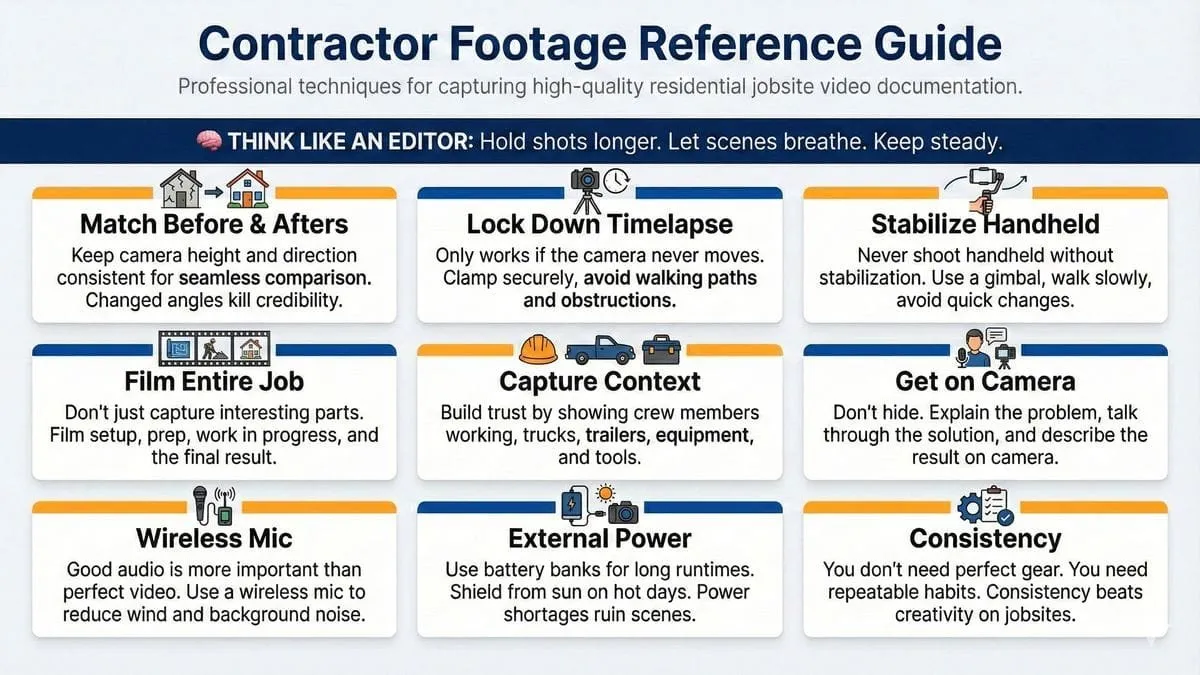
If you’ve ever pulled your phone out on a job site — crew busy, chatty customer, busy day ahead — hit record, and thought “this should be good enough,” this article is for you.
Most job site footage doesn’t get used — not because the work isn’t impressive, but because it wasn’t shot with a plan. What follows is the short, practical explanation of why a few simple habits matter, and how they make your life easier later.
Shoot horizontal first (and why vertical still has a place)
Start by deciding what this footage is actually for.
Vertical video has its place. Fast, punchy clips — like time-lapse lifts or foam expansion — are great for social media and short ads. They grab attention and stop the scroll.
But homeowners researching you as a company want something different. When they’re on your website, they want to see the job site, the setup, the process, the lift, and the finished result. That kind of trust-building content works best in longer, horizontal formats.
Horizontal video gives you more options. It works for your website, YouTube, proposal follow-ups, and sales conversations. Get this decision right early, and everything else becomes easier.
Think like an editor before you hit record
Before you press record, remember: you’re filming for later.
If you’re the one who ends up editing this footage, stable shots and clean beginnings and endings will save you time and frustration. Fast pans and rushed clips feel efficient on-site, but they’re usually the ones you can’t use when you sit down to edit.
Slow down. Hold the camera steady. Let each shot run a few seconds longer than feels necessary. Those extra seconds are what make footage usable.
Match your before-and-after shots exactly
Before-and-after video only works when it’s fair.
If you film the “before” from one angle and the “after” from another, viewers instinctively start questioning the result — even if the lift was perfect. It’s subtle, but it matters.
Pick a starting point. Walk the same path. Hold the camera at the same height and direction. Treat these shots like measurements. When they match, the improvement speaks for itself.
Stability makes your work look as solid as it is
Shaky footage can make excellent work look sloppy.
If you’re shooting handheld, use mechanical stabilization over software-only solutions. A gimbal or a camera with built-in stabilization isn’t about fancy gear — it’s about clarity. Walk slowly. Move deliberately. Avoid quick turns. Calm footage communicates confidence, and confidence is what homeowners are looking for.
Tell the whole job story — not just the lift
The injection or lift might feel like the main event, but homeowners care about more than that.
Show the setup. Show the prep. Show the work in progress. Then show the result. When people see the full process, they don’t just see concrete moving — they see professionalism, care, and competence. That’s what builds trust.
Give every shot a clean beginning and ending
One of the easiest ways to ruin otherwise good footage is starting too late and stopping too early.
Get in the habit of hitting record a few seconds before the action starts and letting it roll a few seconds after it ends. Those extra moments feel unnecessary on-site, but they’re gold when it comes time to edit. Think of it as padding — you may never notice it while filming, but you’ll be glad it’s there later.
Capture the in-between moments on purpose
Not every useful clip is exciting.
Shots of equipment staged, foam expanding, levels being checked, or the crew watching the lift might feel like downtime — but they’re incredibly useful. These moments help with pacing, voiceovers, and transitions. They make the final video feel complete instead of rushed. If you only film the action, you limit your options later.
Get on camera — even if it feels awkward
You don’t need a script. You don’t need perfect delivery.
A short explanation of what the problem was, what you did, and how it turned out goes a long way. People trust hearing directly from the person responsible for the work. Keep it simple. Speak clearly. That human moment often matters more than the footage itself.
Audio can make or break the video
People will tolerate imperfect video long before they tolerate bad sound.
Today’s AI-powered noise-reduction tools are impressive — but don’t make them work harder than they have to. If you’re talking on camera, use a wireless mic. Wind, traffic, and equipment noise can quickly make your message hard to understand. If viewers can’t hear you clearly, they won’t stick around.
Voiceovers make good footage even more useful
Sometimes the best explanation doesn’t happen on the job site.
If equipment noise, wind, or time pressure make on-camera talking difficult, voiceovers are your best friend. Clean, steady footage paired with a simple voiceover recorded later — at your desk, in your truck, or even on your phone — can dramatically improve clarity.
Voiceovers also let you explain things you couldn’t in the moment: why the slab settled, what solution you chose, or what the homeowner should notice in the final result.
Subtitles aren’t optional anymore
A large percentage of people watch video with the sound off — especially on social media.
Adding subtitles makes your videos easier to follow, keeps people watching longer, and helps your message land even when audio isn’t available. For longer-form horizontal videos on your website, subtitles also improve accessibility and comprehension. If you’re already editing the footage yourself, subtitles are one of the highest-return upgrades you can make.
Don’t let dead batteries ruin the best part
Long jobs and time-lapse shots fail more often because of power issues than bad filming.
External battery packs and basic heat protection keep cameras running when you need them most. Losing footage because a camera shut off halfway through the job is frustrating — and completely avoidable.
Consistency beats creativity every time
You don’t need better gear. You need repeatable habits.
Shoot the same angles. Move at the same pace. Follow the same process on every job. Over time, you build a library of footage that can actually be edited, reused, and scaled. Creativity can come later. Consistency is what gets results.
Light branding goes a long way
Branding doesn’t have to mean flashy logos or heavy graphics.
Simple, consistent elements — a small logo in the corner, a basic intro or outro, or your company name and service area on screen — help viewers remember who they’re watching. It reinforces professionalism without distracting from the work. When someone finishes watching, they should immediately know who did the work and how to find you.
Why this actually helps you win more work
When you shoot job site video with intention, it stops being “content” and starts becoming leverage.
Clean, consistent footage builds trust before you ever talk to a homeowner. It shortens sales conversations because people can see your work for themselves. It gives you assets you can reuse across your website, social media, ads, and follow-ups without constantly re-filming. Most importantly, it saves you time — every clip has a purpose, and every job adds value long after the concrete has cured.
Final thought
Shoot slower than you think you need to. Hold shots longer than feels natural. Stay consistent, not clever. Do that, and your job site video stops being clutter — and starts working for you.